1. Church of St Teresa, 14 Aušros Vartų St.
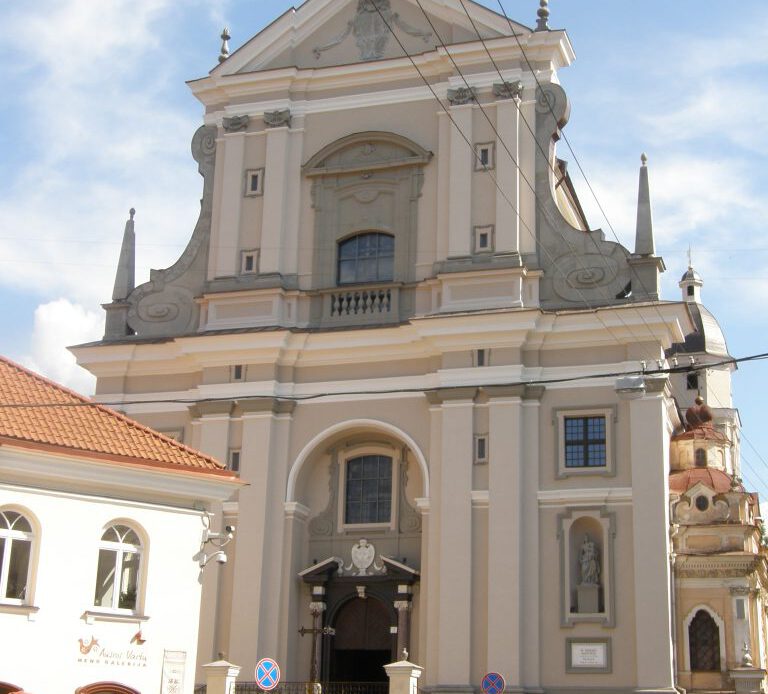
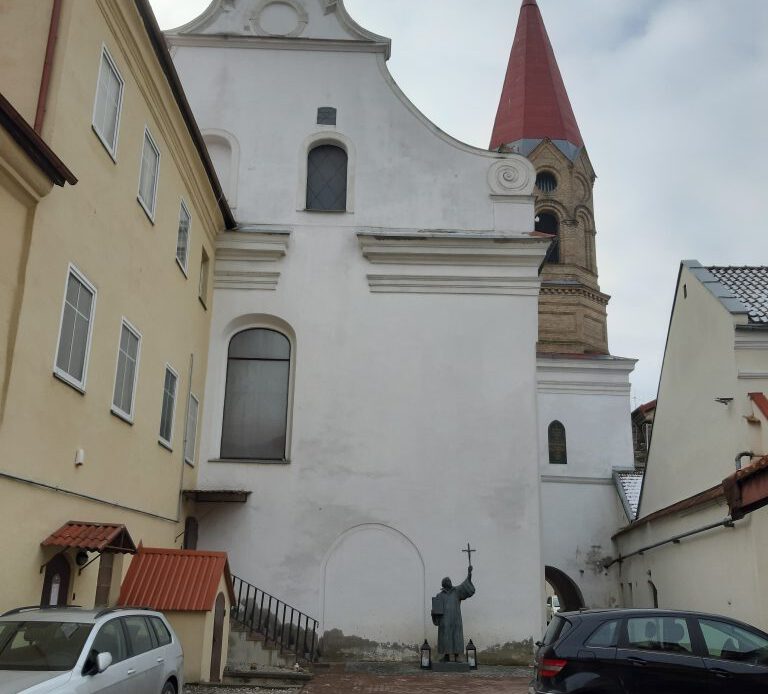
Church of St Teresa. The church was built in the 17th century by Carmelite monks and designed by Italian architects. On the exterior, you can notice the towerless façade characteristic of the Early Baroque, with volutes (spiral-shaped decorative elements) connecting the two levels of the building. The Baroque façade forms a beautiful ensemble with the Chapel of the Gate of Dawn visible at the end of the street. Pay attention to the coat of arms on the church’s pediment (the triangular upper part of the building), featuring a double heraldic lily – the coat of arms of the church’s founder, Stephen Pac, Deputy Chancellor of the Grand Duchy of Lithuania. The Church of St Teresa was never closed, and its 18th-century interior is decorated with frescoes depicting the life of St Teresa.
2. Church of the Holy Spirit, 10 Aušros Vartų St.
Church of the Holy Spirit. This is the most important Orthodox church in Lithuania. The nearby men’s and women’s monasteries are the only Orthodox monasteries currently operating in Lithuania. As early as the late 16th century, there was a monastery, school and printing house here; the masonry church was completed in 1632.
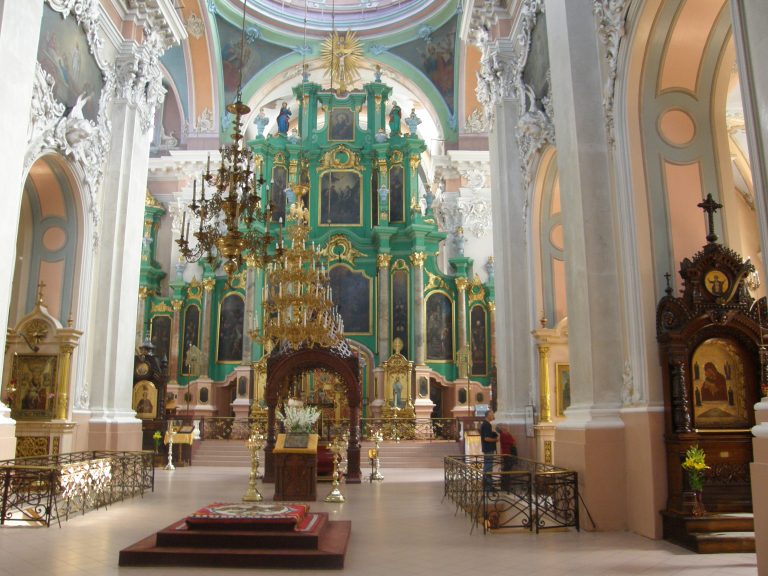
Before entering the church, stop to look at the images of the Orthodox saints John, Eustathius and Anthony painted on the façade above the entrance. Their relics are kept in the church. Inside, pay attention to the layout – this is the only church in Lithuania built according to the Latin-cross plan of a Baroque church. The stucco decorations and sculptures (made from a mixture of plaster, lime, glue and sand) that adorn the interior are also unusual for Orthodox churches.
The interior was reconstructed by the architect Johann Christoph Glaubitz after the fire of 1749. The iconostasis he created (a partition decorated with icons in front of the Orthodox altar) has survived to the present day.
3. Church of the Holy Trinity, Greek Catholic (Uniate), 7B Aušros Vartų St.
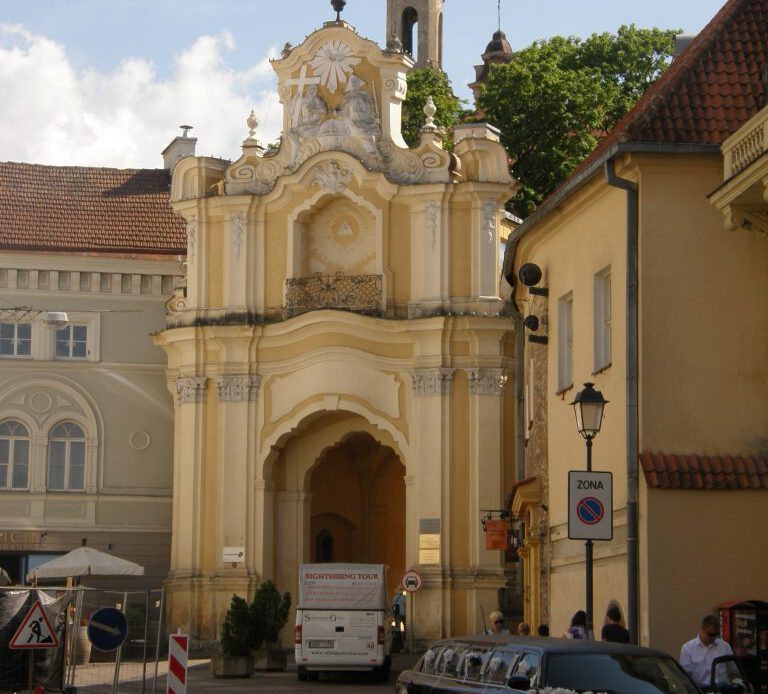
Church of the Holy Trinity, Greek Catholic. This is the only Ukrainian Greek Catholic (Uniate) church in Vilnius, where services are held in Ukrainian. Uniates were Orthodox Christians who converted to Catholicism following the Union of Brest (1596), recognising the authority of the Pope while retaining the Byzantine rite and Church Slavonic language.
The most valuable part of the ensemble is the Baroque entrance gate and towers, designed by the architect Johann Christoph Glaubitz. During the Soviet era, a construction laboratory operated in the church, and the interior was completely destroyed. Restoration work has been underway since 2014, and valuable wall paintings have been discovered and are being restored.
4. Site of the Former Great Synagogue, 5 Žydų St.
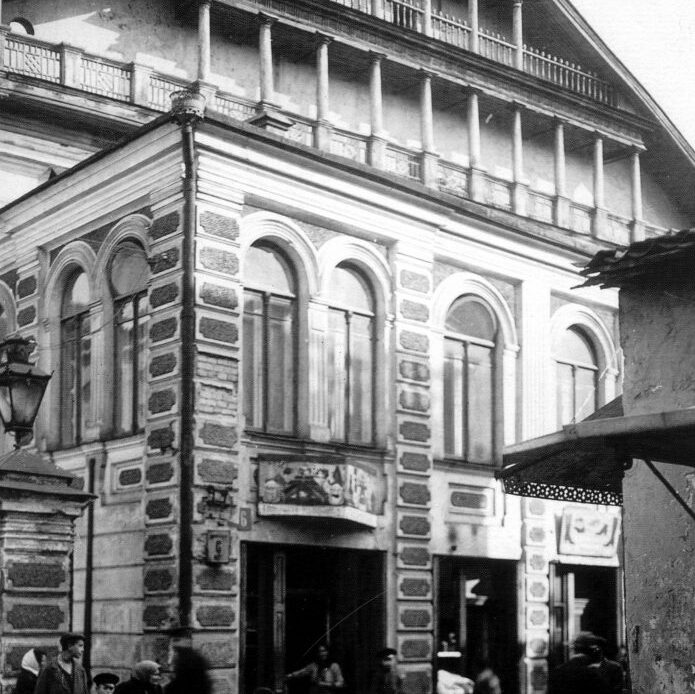
Former Great Synagogue. Did you know that until 1955, the largest and most beautiful Jewish synagogue in Vilnius stood here? The synagogue is mentioned as early as the 16th century. It was surrounded by various courtyards, ritual baths, a yeshiva (educational institution), and Jewish residential houses. In the 18th century, it was reconstructed in the Baroque style. It is believed that its interior was designed by the architect Glaubitz.
The synagogue, damaged during the war, was completely demolished in 1955, and a kindergarten was built on the site. Extensive archaeological research was carried out during the summers of 2018–2026, uncovering the synagogue’s foundations and many other valuable finds.
5. Evangelical Lutheran Church, 20 Vokiečių St.
Evangelical Lutheran Church. Evangelical Lutherans began to establish themselves in Lithuania around 1536, and the church in Vilnius was founded in 1555. The church, together with the community buildings surrounding it, was reconstructed in 1738–1744. The architect Glaubitz, who organised and supervised the construction of the church, was a member of the council of the Vilnius Evangelical Lutheran community. The ornate Baroque altar was created according to his design.
During the Soviet era, the church’s altar was walled up, the sculptures and decorations were destroyed, and workshops and a basketball hall were established in the church. Following restoration in 1988–2005, services of the Evangelical Lutheran community are once again held in the church.
6. Evangelical Reformed Church, 18 Pylimo St.
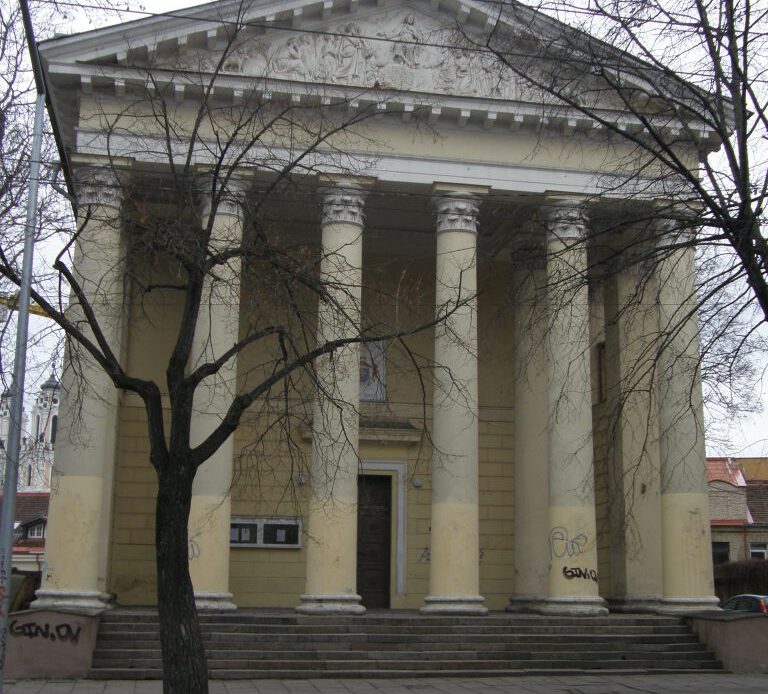
Evangelical Reformed Church. From the late 16th to the 17th century, the Reformed community was persecuted, and its church changed location several times. This Neoclassical-style church was built in 1830–1835 according to a design by the architect Karolis Podczaszyński.
Pay attention to a valuable surviving element of the interior – the church’s wooden ceiling, whose octagonal coffers (decorative recessed ceiling panels) are decorated with painted floral ornaments. The top of the church was originally decorated with two kneeling angels and a female figure symbolising faith, holding a cross and a chalice.
In 1949, the sculptures were removed, and the building was converted into the Kronika documentary cinema. The church was returned to the Evangelical Reformed community in 1990, and restoration has been underway since 2018. The demolished sculptures were reconstructed at the end of 2022.
7. Church of St Nicholas, 4 Šv. Mikalojaus St.
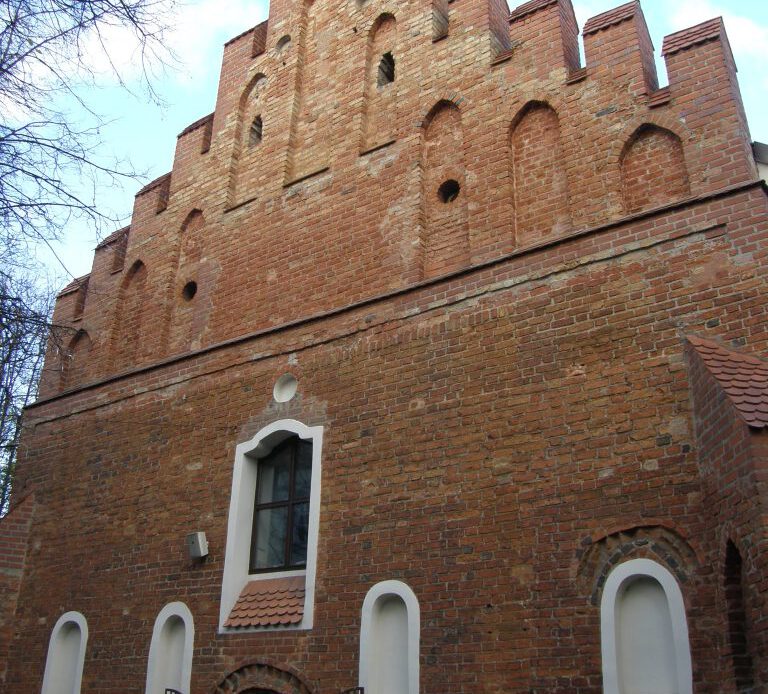
Church of St Nicholas. Did you know that the Church of St Nicholas is one of the oldest churches in Vilnius? The church has preserved the characteristic Gothic forms of the 14th century. First, take a look at the exterior of the red-brick building, where you can see forms characteristic of Early Gothic architecture – a stepped gable (the triangular upper part of the building) and side buttresses (projecting supports that reinforce the walls).
Step inside as well, where you can see painted Gothic vaults. At the beginning of the 20th century, this was the only church in Vilnius where services were held in Lithuanian. Lithuanian intellectuals gathered here, including future signatories of the 1918 Act of Independence of Lithuania.